

Why Evaluation Matters in Leadership Development
August 13, 2026



As psychologists, we are often trusted to design and deliver interventions that support leadership, team and organisational performance. Yet one of the greatest challenges facing our profession is demonstrating that impact in a meaningful way.
Too often, the success of a leadership development programme is judged on participant satisfaction alone, often referred to as Kirkpatrick's Level 1 evaluation. While positive feedback is valuable, it does not answer the critical question: What difference did the intervention actually make?
This is where robust evaluation becomes essential. Effective evaluation provides evidence of value, informs decision-making and strengthens the case for continued investment in leadership development. It ensures programmes are assessed not only on participants' reactions but on whether meaningful change occurred.
Moving beyond “happy sheets”
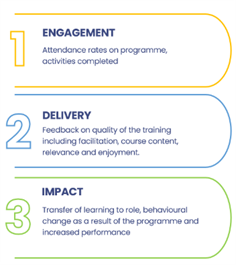
The importance of this distinction is well established. The CIPD highlights that organisations frequently invest significant resources in development programmes but often fail to evaluate whether learning has transferred into improved workplace behaviour and performance (CIPD, 2022). Evidence also suggests that leadership development is most effective when learning is reinforced through practice, feedback, reflection and opportunities to apply new skills in real work settings (Barends et al., 2023).
For psychologists, evaluation helps us understand what works, what does not, and the conditions required for successful behaviour change. This enables us to continually refine our practice and provide more effective support to clients.
The real challenge begins after the programme ends
Reflecting on a particularly busy period of leadership development delivery at The Keil Centre, one theme has emerged consistently: the real challenge begins after the programme ends. While development programmes can increase leaders' awareness, confidence and skills, sustaining behaviour change requires ongoing reinforcement in the workplace. This is why we place increasing emphasis on post-programme evaluation, follow-up activities and opportunities for reflection against leadership development goals. Understanding how leaders continue to apply their learning, and the barriers they encounter, helps us identify what enables lasting change.
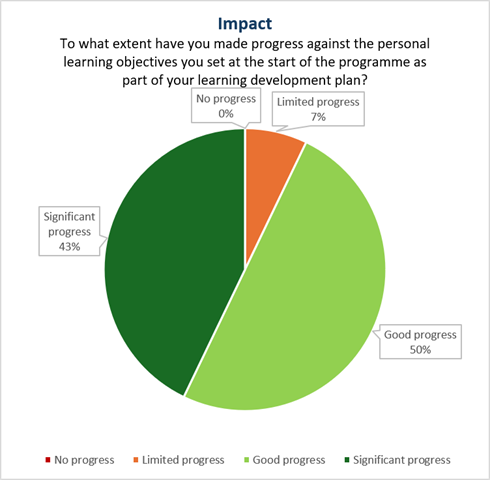
Progress against learning objectives sample data
This has been reflected in client feedback. Janice MacLeod, Director of Measurement at Proserv, observed that one of the most significant outcomes of their recent leadership development programme was “a shift towards greater collaboration and stakeholder engagement”. She noted that managers were actively building stronger relationships across the business, seeking broader input into decisions and communicating change more effectively, leading to faster implementation of improvements and greater confidence in organisational transformation.
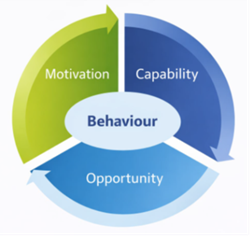
As psychologists, we are uniquely positioned to bring scientific rigour to organisational development. By embedding evaluation throughout the client journey, we move beyond reporting what was delivered and instead provide evidence of what changed as a result. In doing so, leadership development becomes more than a learning event; it becomes a measurable driver of individual, organisational and business success.
Related services
The Keil Centre supports organisations with evidence-based leadership, team and organisational development.
References
Barends, E., Rousseau, D., Janssen, B., Capezzio, A. and Velghe, C. (2023) Leadership Development: An Evidence Review. London: CIPD.
CIPD (2022) Evidence-based L&D: Measuring Learning Transfer. London: CIPD.
Michie, S., van Stralen, M.M. and West, R. (2011) ‘The Behaviour Change Wheel: A New Method for Characterising and Designing Behaviour Change Interventions’, Implementation Science, 6(42).
Find out more
If you would like to discuss leadership development, evaluation or wider organisational development support, our team would be happy to help.