

Build investigation capability that delivers organisation-wide learning
August 13, 2026
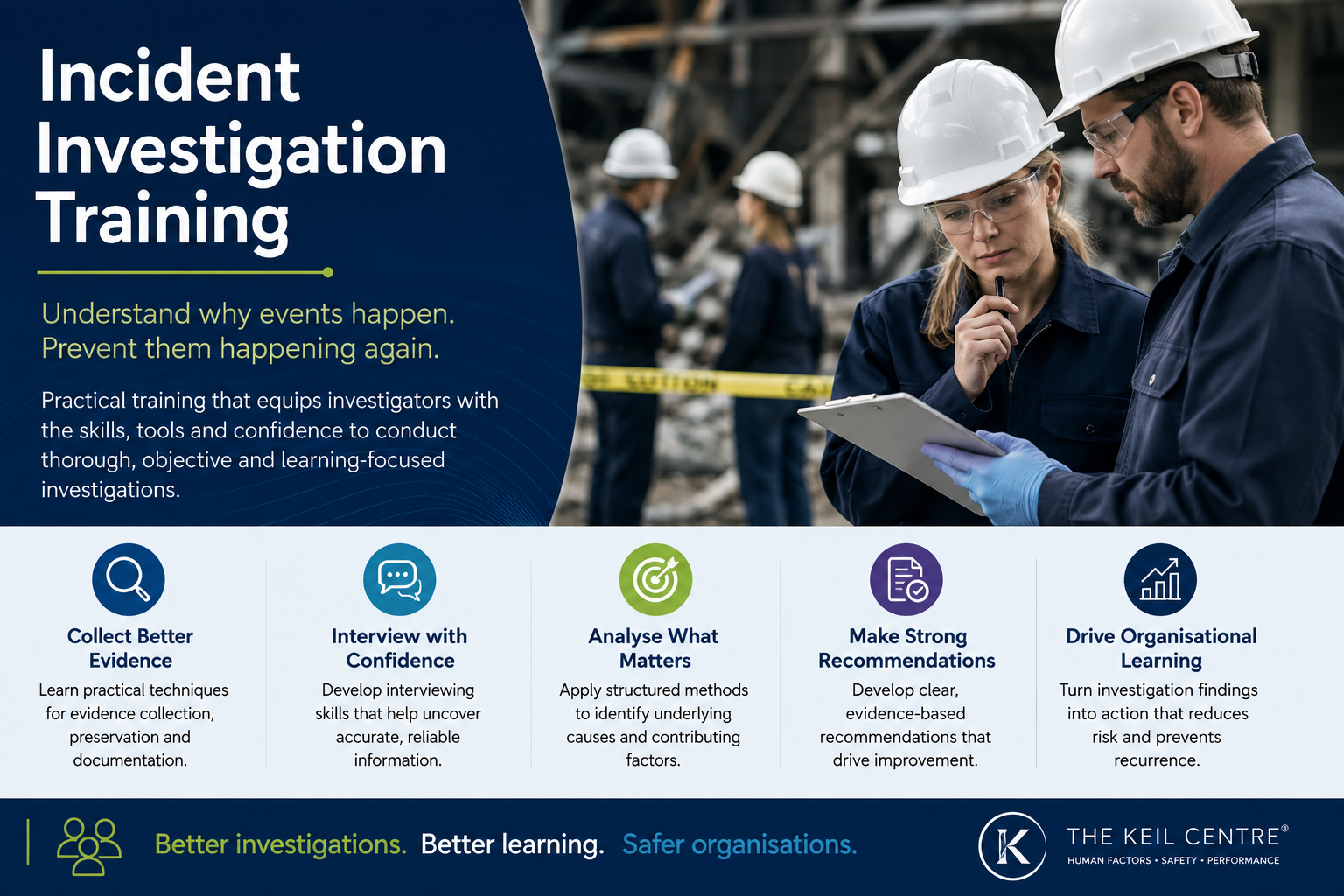



Almost every organisation investigates incidents in some form. The real question is whether those investigations lead to meaningful improvements and lasting organisational learning.
Many investigations successfully establish what happened, but often fall short of explaining why it happened.
Even when organisations ask “why?”, they do not always explore the issue deeply enough. There can be a tendency to focus on immediate factors such as training, procedures, or simply attributing the event to human error.
Without examining the wider organisational, contractual, and external influences, it is difficult to uncover the underlying causes or understand what shaped the actions and decisions involved. If we do not understand the true reasons behind an event, we are unlikely to develop effective solutions that prevent it from happening again.
Does this sound familiar?
Does your organisation investigate incidents but still experience similar events? If so, there is a good chance that some of these deeper issues are not being fully addressed.
Understanding both the what and the why requires a structured investigation process that systematically uncovers the realities of work. Without a clear methodology and an understanding of human and organisational factors, valuable lessons can easily be missed.
For almost 20 years, The Keil Centre has supported organisations in analysing human factors issues through our Human Factors Analysis Tools (HFAT®) training course. Over that time, we have seen that investigators often need more than human factors analysis alone.
In response, we introduced our Investigative Interviewing course last year to help investigators gain richer insights from witnesses. This year, we are expanding our offering further with the launch of our new Investigation Essentials course.
Introducing Investigation Essentials
Our new three-day Investigation Essentials course is designed as a practical first step for investigators. It provides the knowledge and structure needed to approach investigations in a methodical, organised, and objective way, helping to deliver more thorough, learning-focused outcomes.
Participants learn the essential stages of a structured investigation process, including:
- Planning and organising an investigation
- Identifying, collecting and evaluating information
- Analysing gathered data to understand influences on human behaviour and performance
- Developing effective, efficient, and sustainable recommendations
- Writing clear investigation reports
- Sharing lessons learned across the organisation
The course equips investigators with practical tools and techniques that support high-quality investigations and meaningful organisational learning.
Developing long-term investigation capability
Investigation Essentials sits within our wider Investigator Development Pathway, which currently includes:
1. Human Factors Awareness
Introductory level
2. Investigative Interviewing
Practitioner level
3. HFAT®
Human Factors Analysis Tools — practitioner level
4. Psychological Safety and Just Culture
Associated course
Further programmes in development
We are also planning to introduce two additional programmes next year:
- Human Factors Deep Dive for Investigators — advanced level
- Managing Your Investigation Capability — for managers and supervisors
Together, these courses support the guidance set out in the Energy Institute’s recently published guide, Reporting, Investigating and Learning from Incidents, Accidents and Events (EI3295).
The programme helps organisations develop investigators who can identify not only immediate causes, but also the wider organisational and human factors that influence safety performance.
Strengthen investigation capability
If you are looking to strengthen investigation capability within your organisation, we would be delighted to discuss both public and in-house delivery options.